
So, you’re searching online for help with a renovation or remodel in St. Louis. You want to start your search, but you have ads and links to contractors, remodeling companies, construction companies, and design-build firms lined up next to each other. At first glance these all look like the same thing to the uninitiated, but that couldn’t be further from the truth. Fact is, they’re all immensely different, and hiring the wrong type for your project scope is how budgets get blown, fingers get pointed, and worlds explode (okay, maybe not that serious, but it is a problem). You want a clear, manageable understanding of what each of these companies does, and it’s not that hard to tell them apart once you know what you’re looking for.
The Three Types, Defined
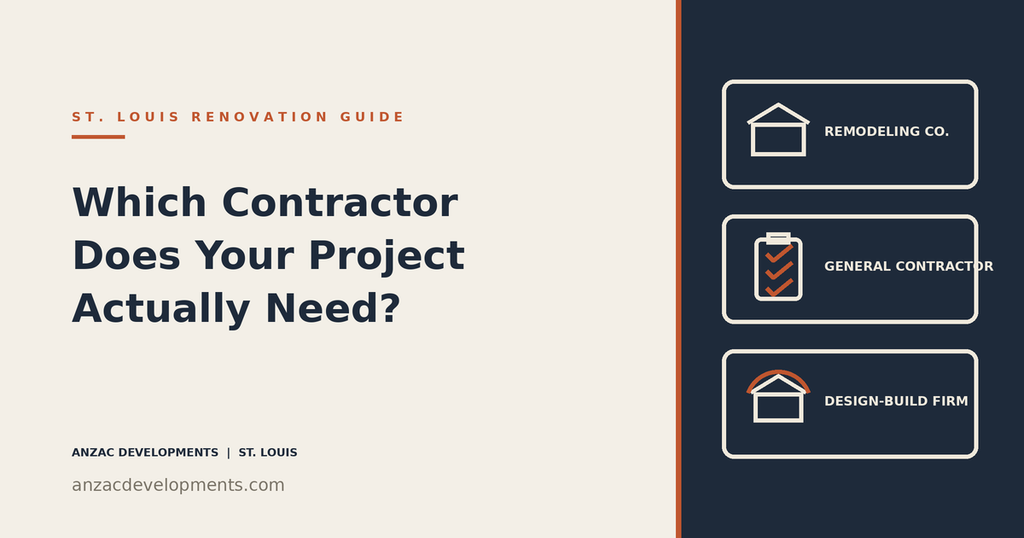
First, let’s get the differences out of the way. A remodeling company specializes in renovating existing spaces, specifically interior spaces. They usually come in with an in-house crew (meaning no subcontractors) and are most reliable in areas that often need updating: think kitchens and bathrooms.
A general contractor manages almost all types of construction; think of them as the “jack of all trades” type. They coordinate subcontractors for nearly all facets of the job, and their responsibilities usually include scheduling, budgeting, and permitting. This is the best option when you have a finished design in mind and want it built by a quality company.
A design-build firm starts from the ground up. They help you not only build your remodel, but design it from phase one and beyond, all under a single contract with one team. Pricing usually happens while the design is being drawn, not once the project is started or completed.
You’ll run into a few adjacent terms while you search, too. A construction company is the umbrella term, usually interchangeable with general contractor, though some construction companies self-perform the work with their own crews instead of coordinating subcontractors. Home contractor is informal shorthand for a residential general contractor. A handyman handles small repairs and punch-list jobs, usually nothing that requires a permit, and is not who you call for structural work. And a custom home builder is simply a general contractor who specializes in ground-up new homes.
The Traditional Path: Architect Plus General Contractor
The traditional path is simple: hire an architect to map out your design, then hire a general contractor to build it. There are numerous benefits to this. You are not beholden to one company to manage everything, and by bidding the finished plans to multiple contractors, you can often get sharper pricing. Highly custom work is also much more manageable this way, since the architect can design independently and the contractor can focus purely on execution. However, plans can change, and it creates real problems if the original design turns out to be over budget or unbuildable once bids come back; redesign loops cost both time and money. It can also stretch the timeline, since the designer and the builder aren’t naturally in sync.
The Design-Build Path
In the design-build path, everything is run by one company. The contractors, the designers, the permits, and much more are all under one roof. This also means cost is often the first thing talked about and the last thing you have to worry about: the budget conversation happens before you see your first mock-up. It sounds great, until you see the price tag, though part of that sticker shock is simply that design fees are wrapped into a single number instead of billed separately. The real tradeoff is that you lose the ability to independently bid out contracts, making it harder to know whether you’re getting the best price on each piece of the job. That’s why vetting the firm up front matters even more in this model; we wrote a full guide on how to vet a general contractor in St. Louis that applies here word for word.
Which One Does Your Project Actually Need?
Match the company to the scope. A single-room cosmetic refresh, like a kitchen or bathroom update, is squarely remodeling company or general contractor territory. If you already have stamped architectural plans in hand, you need a general contractor, full stop: the design work is done, and what you need now is an expert builder. A whole-home renovation, an addition, structural changes, or a historic property points to design-build or the architect-plus-GC route, because those projects live or die on how well design and construction communicate with each other. And if you have a hard budget ceiling and want the design shaped to fit it, rather than the other way around, design-build was invented for exactly that. Still stuck? Here’s a tiebreaker: when something goes wrong at week nine (and something always goes wrong at week nine), how many phone numbers do you want to have to call?
Where the Money Actually Sits
No matter which model you choose, you’re paying for the same four things: design, materials, labor, and management. What differs is where those costs surface. In the traditional path, architect fees typically run somewhere around 8 to 15 percent of construction cost, and the general contractor adds an overhead and profit markup, commonly cited in the 10 to 20 percent range, on the work they coordinate. Design-build wraps design into a single contract, which is why the number can look bigger up front even when the totals are comparable. Here’s the honest truth: no model is automatically the cheapest. They differ in when you get cost certainty. Design-build prices the project while you design it; the traditional path prices it after the design is finished, which is where those redesign loops are born. To see what these totals look like on a real project, check out our breakdown of what a home addition really costs in St. Louis.
The St. Louis Answer: It Depends (and That’s Good News)
Here’s where we’re supposed to tell you which one to hire, and our honest answer is: it depends on your project. Anzac Developments operates as both a general contractor and a design-build firm here in St. Louis, so we have no horse in this race. We’ve delivered projects both ways, and one conversation about your scope, budget, and timeline is usually enough to tell you which model fits. Contact us online and bring your idea: one conversation beats ten more Google searches.
Frequently Asked Questions
Is design-build cheaper than hiring an architect and contractor separately? Not automatically. The totals are often comparable. The difference is when you get cost certainty: design-build prices the project during design, while the traditional path risks expensive redesign if bids come back over budget.
Do I need an architect for an addition? For anything structural, yes. Stamped drawings are generally required to pull permits in the City of St. Louis and most surrounding municipalities. The real choice is whether you hire the architect yourself or get one through a design-build firm.
What’s the difference between a remodeling company and a general contractor? Scope. Remodelers specialize in interior renovations, often with in-house crews. General contractors manage projects of nearly any size and complexity by coordinating specialized subcontractors.